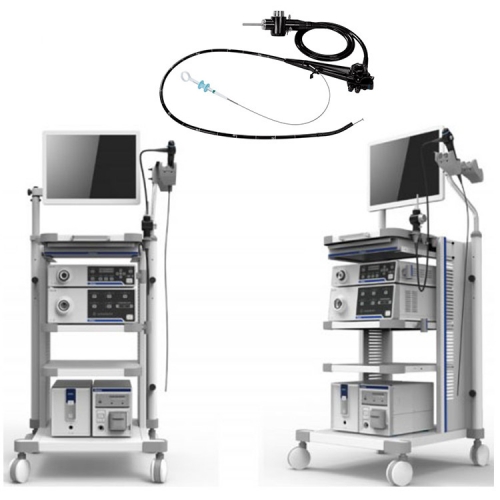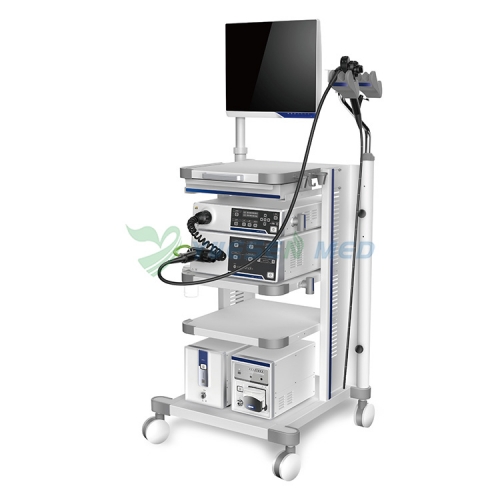
4K imaging principle: 4K resolution technology is used to present images through a large number of pixels, usually up to 3840×2160 pixels, making the image more detailed and clear, allowing doctors to observe more subtle tissue characteristics and lesions. The principle of fluorescence imaging: Using the characteristics of fluorescent substances, the patient is first injected or locally used with fluorescent contrast agents, such as indocyanine green (ICG). These contrast agents accumulate in specific tissues or lesions. When illuminated with a specific wavelength of light, the contrast agent is excited and fluoresces at different wavelengths. The endoscope's optical system and sensors capture these fluorescent signals, which are then processed and fused with 4K white light images or displayed separately to help doctors navigate and position accurately during surgery.
Unlock the next dimension of surgical oncology and perfusion assessment with the 4K Fluorescence Imaging Endoscopy System. This cutting-edge platform integrates near-infrared (NIR) fluorescence imaging capability with stunning UHD 4K white light visualization. Utilizing Indocyanine Green (ICG) dye, the system illuminates critical structures invisible to the naked eye, such as real-time blood flow, lymphatic tissue, biliary anatomy, and tumor margins. The dual-mode functionality (switching seamlessly between 4K white light and NIR fluorescence) provides surgeons with unparalleled intraoperative information, enhancing decision-making in complex oncologic, hepatobiliary, and reconstructive surgeries. Experience improved precision in tumor resection and vital structure identification.
Chinese, English, Russian, Japaneseand Spanish can be switched
4K Fluorescence Imaging Endoscopy Advantages
1. Superior image quality: The 4K imaging system offers four times the resolution of 1080p and nine times the resolution of HD imaging systems. This high resolution provides exceptional image clarity and detail, allowing surgeons to see fine structures and subtle changes during the surgical procedure. 2. Enhanced color reproduction: 4K fluorescence laparoscopy systems utilize advanced image processing technology and optical design to reproduce accurate and vivid colors within the surgical field. This enables surgeons to observe patterns, structures, and abnormalities in high precision, facilitating better identification and treatment. 3. Fluorescence imaging: The addition of fluorescence technology in 4K laparoscopy allows the use of contrast agents, such as indocyanine green (ICG),which can highlight specific tissues orstructures. When ICG is administered and visualized under near-infrared light, it emitsa fluorescent signal, enabling surgeons to clearly identify lymphatic vessels, lymph nodes, blood vessels, and tumors. This can help in identifying sentinel lymph nodes,assessing tissue perfusion, and determining the boundaries of tumors. 4. Real-time visualization: 4K fluorescence laparoscopy provides real-time imaging and visualization, allowing surgeons to observe the surgical field in high definition during the procedure. This can aid in making more accurate decisions and performing precise surgical interventions. 5. Wide range of applications: 4K fluorescence laparoscopy has applications in various surgical procedures, including gastrointestinal surgery, urology surgery, gynecology, and hepatobiliary surgeries. It can assist in surgeries involving the liver, pancreas, bile ducts, blood vessels, and lymphatic system, improving accuracy and surgical outcomes.
4K Fluorescence Imaging Endoscopy Key Features
1. Dual-Mode Ultra-High-Definition Visualization
Stunning 4K White Light Imaging: Experience exceptional detail with brilliant, true-to-life color reproduction and superior depth of field. This provides the foundational, high-resolution anatomical context necessary for precise dissection and navigation.
Near-Infrared (NIR) Fluorescence Imaging: Unlock real-time, functional imaging of critical subsurface structures that are invisible to the naked eye. This capability reveals vital physiological information beyond anatomical landmarks.
2. Precision Perfusion and Tissue Assessment with ICG Intraoperative Angiography: Utilize the FDA-approved contrast agent Indocyanine Green (ICG) to dynamically visualize and assess real-time blood flow and tissue perfusion in vessels and microvasculature. This is critical for ensuring anastomotic viability in reconstructive surgeries.
Enhanced Viability Assessment: Make confident decisions about tissue health and resection margins by objectively evaluating blood supply, potentially reducing postoperative complications. 3. Advanced Tumor Margin Delineation Precision Resection Guidance: The system actively illuminates tumor margins and malignant tissue, providing real-time visual feedback that helps surgeons achieve cleaner resection margins while preserving healthy tissue.
Improved Oncologic Outcomes: By enabling more complete tumor excision, the system contributes to reducing positive margin rates and potentially lowering the risk of local recurrence. 4. Critical Structure Identification Biliary Anatomy Mapping: Clearly visualize the extrahepatic biliary tree during hepatobiliary surgeries, aiding in identification and helping to prevent iatrogenic injuries.
Lymphatic System Visualization: Identify and assess lymphatic vessels and lymph nodes, which is invaluable for staging and targeted biopsies in oncologic procedures. 5. Seamless, Integrated Surgical Workflow Instant, Toggle-Free Switching: Effortlessly alternate between 4K white light and NIR fluorescence modes with a simple foot pedal or touch-button control. This seamless integration eliminates workflow disruption and allows for simultaneous anatomical and functional assessment. Picture-in-Picture Display: Optionally view both imaging modes simultaneously on a single screen, overlaying fluorescent data onto the ultra-HD white light image for intuitive interpretation and spatial context. 6. Unparalleled Intraoperative Decision-Making Surgical Navigation: Gain a comprehensive information advantage by seeing both detailed anatomy and functional physiology in real-time. This empowers surgeons to make more informed, confident decisions during complex procedures.
Broad Application Range: The system is uniquely designed to enhance precision across a wide spectrum of specialties, including surgical oncology, hepatobiliary, colorectal, reconstructive, and thoracic surgeries. 7. Enhanced Ergonomics and Usability User-Intuitive Interface: Designed with the surgical team in mind, featuring an intuitive control system and customizable settings to adapt to specific procedural needs and surgeon preferences.
Optimized for the OR: The system is built to integrate smoothly into the operating room environment, supporting sterility and efficient workflow without obstructing the surgical field. 4K Fluorescence Imaging Endoscopy Applications
1.Surgical Oncology: Precision Tumor Resection
This is a primary application where the system proves invaluable. The ability to define tumor margins in real-time addresses a critical challenge in cancer surgery.
Real-Time Tumor Margin Delineation: After intravenous injection, ICG dye tends to accumulate in hypervascular tissues and leak through the abnormal vasculature of tumors. Under NIR fluorescence, these areas "light up," providing the surgeon with a clear visual map of the malignant tissue against the background of healthy tissue. This is particularly crucial for:
Gastrointestinal Cancers: For gastric, colorectal, and pancreatic cancers, ensuring a complete resection (R0 resection) is paramount for patient prognosis. The system helps identify subclinical or ill-defined lesions that are invisible under white light alone.
Hepatic Tumors: Liver metastases and hepatocellular carcinomas can be difficult to distinguish from surrounding parenchyma. ICG fluorescence allows for precise demarcation, guiding parenchymal-sparing resections.
Lymph Node Mapping: ICG is injected around the primary tumor site and is drained by the lymphatic system. The system allows surgeons to track the dye in real-time, identifying the sentinel lymph nodes (the first nodes draining the tumor) with high accuracy. This enables targeted lymphadenectomy, reducing unnecessary dissection, minimizing morbidity (like lymphedema), and providing critical staging information.
2. Hepatobiliary and Pancreatic Surgery: Visualizing Complex Anatomy The biliary system's intricate and variable anatomy poses a significant risk of iatrogenic injury. This system acts as an "X-ray vision" tool for surgeons.
Real-Time Biliary Imaging: ICG is excret exclusively by the liver into the bile. This causes the entire biliary tree—including the cystic duct, common bile duct, and hepatic ducts—to fluoresce brightly. This application is vital for:
Cholecystectomy: Prevents common bile duct injury by clearly outlining the biliary anatomy before any cuts are made, making laparoscopic cholecystectomy significantly safer.
Hepatectomy: During liver resections, visualizing the biliary structures within the resection plane helps avoid leaving open ducts that can lead to post-operative bile leaks.
Hepaticojejunostomy and Biliary Reconstruction: Provides immediate confirmation of a patent and leak-free anastomosis by visualizing bile flow through the connection.
Liver Perfusion Assessment: After resection, the system can assess blood flow and viability of the remaining liver segments. By injecting ICG, surgeons can verify that the remnant liver has adequate arterial and portal inflow, crucial for preventing post-hepatectomy liver failure.
3. Reconstructive and Plastic Surgery: Ensuring Tissue Viability The success of flaps and grafts in reconstructive surgery is entirely dependent on robust blood perfusion. This system moves perfusion assessment from subjective judgment to objective visualization.
Perfusion Assessment of Flaps: Surgeons can inject ICG intraoperatively to evaluate blood flow to a tissue flap (e.g., a DIEP flap for breast reconstruction) before, during, and after transfer. This allows them to:
Select the optimal perforator for flap harvest based on perfusion quality.
Confirm adequate arterial inflow once the flap is inset.
Verify venous outflow, preventing congestion and flap failure.
Burn Surgery: It can accurately differentiate between viable and non-viable (necrotic) tissue in severe burn cases, guiding the extent of debridement and improving grafting success rates.
4. Vascular and Transplant Surgery
Anastomosis Patency: In vascular surgery, the system can confirm the successful flow of blood through a newly connected anastomosis (e.g., after bypass surgery or organ transplantation).
Organ Viability: In kidney transplantation, for instance, it can be used to assess the perfusion of the donor organ immediately after reperfusion, providing an early indicator of its function.
Summary of Clinical Benefits:
Enhanced Surgical Precision: Transforms surgery from reliance on anatomy and touch to real-time, functional visualization.
Improved Oncologic Outcomes: Increases the likelihood of complete tumor removal (R0 resection) while preserving healthy tissue.
Reduced Complications: Lowers the risk of iatrogenic injuries to bile ducts, blood vessels, and other critical structures. Minimizes rates of anastomotic leak and flap failure.
Informed Intraoperative Decision-Making: Provides immediate, critical information that can change the surgical plan, leading to more personalized and effective care.
Potentially Shorter Operative Times: Reduces time spent searching for structures or assessing tissue viability.
Get Price
Write down your demand below and we will contact you within 24h!